
The complete guide to duty of care in school transport
Every school day, thousands of Australian students place their safety in the hands of school administrators and bus operators. Understanding your duty of care, and proving it, is one of the most critical risk-management challenges your school faces.

For school principals and business managers, the responsibility is immense and the stakes could not be higher. The legal and emotional weight of student safety does not end at the school gate. It extends until every student safely reaches their destination. If something goes wrong along the way, the school is accountable.
A single oversight, a student boarding the wrong bus, alighting at the wrong stop, or being left behind on a parked vehicle, can lead to severe legal consequences, financial penalties, and lasting trauma for the whole school community.
This guide covers everything you need to know:
- The legal foundation of duty of care in Australian school transport
- What the law actually requires, state by state
- Why manual systems are a liability
- How digital tools create the compliance proof you need
- A practical checklist to assess your school's current posture
What does duty of care mean in Australian school transport?
In Australian education, duty of care is not a policy guideline or a box to tick. It is a fundamental legal obligation grounded in the common law of negligence, and it carries real-world consequences for every school that manages student transport.
At its core, the duty requires schools and their staff to take reasonable steps to prevent reasonably foreseeable harm to students in their care. Courts expect schools to have a proactive, systematic approach to identifying and managing risks, especially in environments as dynamic and high-stakes as school bus transport.
The non-delegable nature of the duty
Here is the part that surprises many administrators: you cannot hand this responsibility off. The High Court of Australia confirmed this principle in the landmark case Commonwealth v Introvigne. Even when a school contracts a private bus company or a third-party transport provider, the school keeps an overarching duty to ensure student safety. Contracting out the service does not contract out the liability.
The duty of care owed by a school to its pupils is non-delegable. It cannot be discharged simply by entrusting the task to another.
This means a school cannot argue ignorance or defer responsibility if a transport incident occurs. The school must keep active oversight of transport arrangements, including supervision systems, real-time monitoring, and verifiable record-keeping.
When does the duty begin and end?
The scope of duty of care is broader than many administrators realise. It is not confined to the moment a student walks through the front gate. Under South Australian regulations, children are considered to be under the care of the service from the point at which it assumes responsibility for their wellbeing, specifically, when the child begins the journey on transport provided or arranged by the service. This principle is broadly consistent across all Australian jurisdictions.
The duty also extends beyond the physical boundaries of the campus. In the significant 2025 New South Wales Court of Appeal decision, State of New South Wales v T2 (by his tutor T1), the court unanimously upheld a $1.75 million damages award against a school that had failed to supervise a bus stop located outside its grounds, where a student was assaulted.
Key school-transport legal facts
Non-delegable duty
Contracting a bus company does not transfer your liability for student safety.
Responsibility beyond the gate
Your duty extends past school grounds and hours to include supervised bus stops.
Real legal consequences
A NSW school was ordered to pay $1.75M for failing to supervise a bus stop.
The regulatory landscape: national standards and state obligations
Common law establishes the overarching duty of care. Specific legislative and regulatory frameworks then set out the precise operational requirements that schools and transport providers must follow. You need to understand both the national framework and the state-specific obligations for full compliance.
The ACECQA national framework and the March 2023 changes
The Australian Children's Education and Care Quality Authority (ACECQA) administers the National Quality Framework under the Education and Care Services National Law and National Regulations 2011. A series of significant changes took effect on 1 March 2023, prompted by a concerning pattern of serious incidents in which children were left unattended in parked vehicles, or failed to arrive at a service without staff being able to confirm whether the child had ever boarded.
The new requirements under Regulations 102E and 102F apply to centre-based services that provide or arrange regular transportation:
- Supervision at embarkation and disembarkation a nominated supervisor or staff member (someone other than the driver) must be physically present when children board and alight at the premises.
- Individual accountability that staff member must account for each child by name.
- Vehicle interior check after all children have disembarked, a thorough check of the vehicle's interior must confirm no child remains on board.
- Immediate record-keeping time-stamped records, including the full name and signature of the responsible person, must be created immediately and retained for three years.
- Mandatory notification providers must notify their regulatory authority within seven days of commencing or ceasing regular transportation.
State-by-state regulatory obligations
Beyond the national framework, each state and territory enforces its own legislation governing school transport safety. The table below summarises the key frameworks and obligations in each jurisdiction.
| State / Territory | Key regulatory framework | Primary transport obligation |
|---|---|---|
| Victoria | Bus Safety Act 2009; Bus Safety Regulations 2020; Ministerial Order 1359 | Coordinating principals must maintain bus rolls. Ministerial Order 1359 defines school environment broadly to include any place used outside school hours, meaning bus stops and transport hubs may fall within scope. |
| New South Wales | Civil Liability Act 2002; Education Act 1990 | Schools must take reasonable precautions against foreseeable harm in all transport environments, including off-campus bus stops. The 2025 T2 ruling significantly expanded the practical scope of this obligation. |
| Queensland | Transport Operations (Passenger Transport) Act 1994; Safety Management Framework (2024/2026) | Operators must hold specific accreditation. From February 2024, new laws introduced a general safety duty for all road-based public passenger services, with enhanced obligations from February 2026. |
| Western Australia | Education and Care Services National Law (WA) | Strict enforcement of mandatory disembarking checks. In March 2026, the State Administrative Tribunal ordered a service to pay $25,000 after a seven-year-old was left on a locked bus in 39-degree heat. |
| South Australia | Education and Early Childhood Services (Registration and Standards) Act 2011 | Requires comprehensive risk assessments, specific parental authorisations, and detailed records. Duty of care explicitly commences the moment a child begins their journey on service-arranged transport. |
| All states and territories | Education and Care Services National Regulations 2011 (Regs 102E and 102F, from March 2023) | A staff member (not the driver) must supervise embarkation and disembarkation; a vehicle interior check is required; time-stamped records kept for three years; $2,000 penalty per breach. |
The dangerous visibility gaps of manual systems
Despite these strict requirements, many Australian schools still rely on paper manifests and basic spreadsheets to manage daily bus routes. These outdated systems create significant visibility gaps, periods during which a school cannot definitively confirm a student's location or safety status.
The problem begins the moment a paper manifest is printed. That document is a static snapshot of an intended journey, not a live record of what is actually happening. Consider what happens when:
- A parent calls to report their child is absent. The driver has no way of knowing.
- A student boards an alternative bus at the last minute. The original manifest stays unchanged.
- A student fails to alight at their designated stop. Neither the school nor the parents receive any alert.
- A driver is distracted during disembarkation. There is no system to enforce a vehicle check.
The system is entirely reactive. By the time a problem is identified, precious time has already been lost.
The human cost of visibility gaps
The consequences of these gaps are not theoretical. The data is sobering.
In Ellenbrook, Western Australia, the child was only discovered by chance when an educator walked past the bus and heard the distressed child calling for help. Staff had simply failed to conduct the mandatory disembarking check.
Supervision is the single most important step in keeping children safe. It is non-negotiable. There is no substitute for supervision.
These incidents are not the result of malicious intent. They are the predictable outcome of placing too much reliance on human memory and manual processes in high-pressure, dynamic environments.
The compliance proof problem
Beyond the immediate safety risk, manual systems create a significant compliance proof problem. When a regulatory authority or a court asks a school to demonstrate that it fulfilled its duty of care on a specific day, a paper manifest cannot show that a staff member was present during disembarkation, that a vehicle check was completed, that parents were notified in real time, or that the driver was alerted when a student boarded the wrong bus.
Without a verifiable, time-stamped audit trail, a school is left relying on the recollections of individual staff members, precisely the kind of evidence that courts and tribunals find least persuasive.
Paper manifests vs RollCall digital
The gap between a static paper snapshot and a live, provable record of every journey.
Paper manifests
- Static data, a snapshot, not a live record
- No real-time alerts
- No verifiable audit trail
- No wrong-bus detection
- No vehicle-check enforcement
- No parent notifications
RollCall digital system
- Live admin dashboard
- Instant parent notifications
- Immutable, time-stamped audit trail
- Wrong-bus and wrong-stop alerts
- Bus Guardian end-of-route checks
- Three-year compliant record storage
Digital accountability: proving your duty of care
To truly fulfil their duty of care, and to be able to prove it, schools must move from reactive manual processes to proactive digital accountability. Modern school bus management software provides the definitive compliance proof required by law, and turns a complex operation into a streamlined, secure and verifiable service.
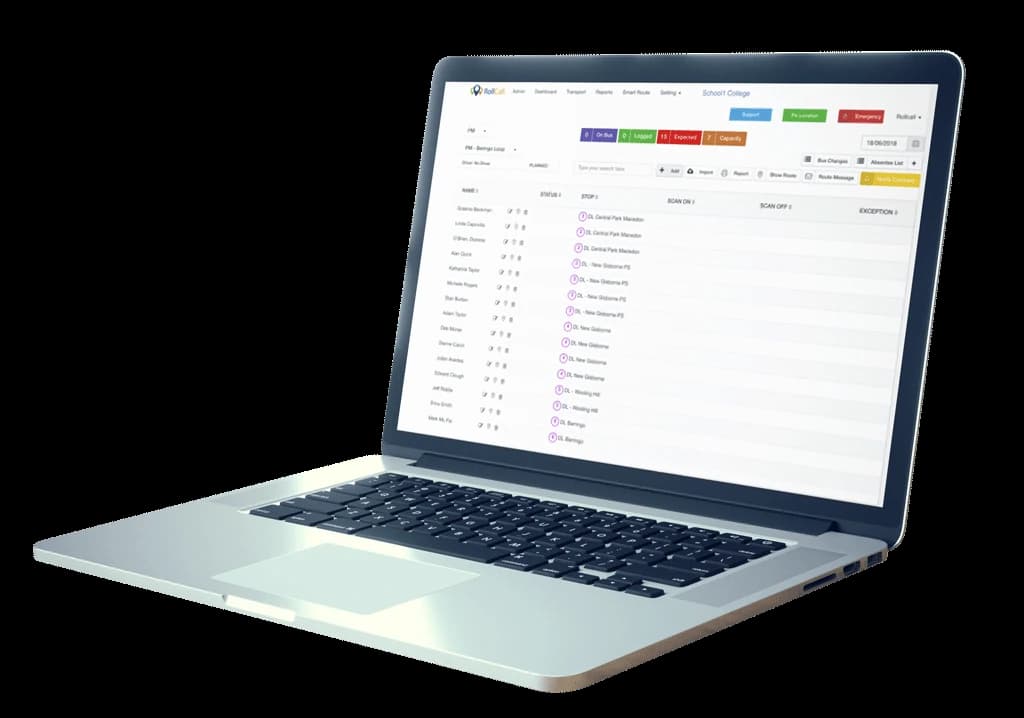
The foundation of digital compliance
With RollCall, students tap on and tap off the bus using a dedicated NFC tag or their existing student ID card, scanned on a smart device securely mounted in the vehicle. This single action triggers several compliance-critical events at once:
- Parents are instantly notified through the RollCall app that their child has boarded.
- The school's admin dashboard updates in real time. The digital manifest fills automatically.
- The driver is immediately alerted if a student boards the wrong bus or tries to alight at the wrong stop.
- A time-stamped, location-stamped digital record is created and stored securely in the cloud.
- When the student taps off, parents receive a second notification confirming safe arrival.
Every event is immutably recorded. A cloud-based, ISO 27001-certified system automatically generates and stores the records required under Regulations 102E and 102F for three years, giving you instant, definitive proof of supervision, available for inspection at any time.
Eliminating the left-behind risk
To address the most critical risk in school transport, children being left unattended on vehicles, RollCall built the Bus Guardian module, now included in the core product at no extra charge. It enforces a physical, auditable check at the end of every run.
The result: it is virtually impossible for a driver to finish a run without physically walking the full length of the bus. This directly satisfies the regulatory mandate for interior vehicle checks under ACECQA Regulation 102F, and creates the verifiable, time-stamped evidence that protects schools in the event of a regulatory inquiry or legal challenge.
How Bus Guardian works
- 1
Route ends
The digital manifest confirms all students have tapped off and disembarked.
- 2
Driver walks the bus
The driver walks to the very back of the vehicle, the only way to complete the check.
- 3
Scans the check board
The driver scans the physically mounted Bus Check Board at the rear.
- 4
Confirmation uploaded
A time-stamped, location-stamped confirmation uploads instantly to the cloud.
- 5
Compliance proven
School admin receives auditable proof the bus is clear, satisfying ACECQA Reg 102F.
Integrating transport with school management
Putting a digital transport system in place should improve, not disrupt, your existing school operations. For straightforward compliance, transport data must not sit in a silo. It must connect to the broader school management ecosystem.
Integration with school management systems
Leading transport platforms integrate directly with industry-standard school management systems, including Sentral and TASS. This delivers several practical benefits:
- Student data is automatically synchronised new enrolments create transport profiles immediately.
- Parent contact information is always current no manual data entry or outdated records.
- Medical alerts travel with the student drivers always have access to life-saving information.
- Absence data flows both ways a bus absence triggers a school alert, and a school absence prevents unnecessary bus bookings.
When a parent updates their mobile number in the school management system, the driver's device reflects the change in real time. This removes the data-entry errors and outdated records common in siloed systems, errors that can have life-or-death consequences when a driver needs to contact a parent in an emergency.
The RollCall integration ecosystem
Secure, real-time data flowing from the bus to every stakeholder, and into the systems your school already runs.

Built on Python Django and React
 ISO 27001 certified
Direct, certified integrations, plus single sign-on for nearly everyone else.




Fees and bus bookings, reconciled automatically.




Data security and privacy obligations
For the K-12 sector, the security of student data is paramount. Schools are subject to the Privacy Act 1988 (Cth) and, in many states, additional state-based privacy legislation. When you select a provider, look for:
- ISO 27001 certification the internationally recognised standard for information security management.
- Cloud infrastructure with geographic data residency data stored in Australia, not offshore.
- Role-based access controls limiting who can view sensitive student information.
- Audit logs a record of who accessed what data, and when.
The parent engagement dimension
Digital transport management also changes the relationship between schools and parents. Rather than waiting anxiously for their child to arrive home, parents receive real-time notifications at every stage of the journey. This transparency builds trust and confidence, reduces the volume of enquiry calls to administration, makes parents the first to know if any deviation occurs, and for students with additional needs or medical conditions, provides critical real-time safety visibility.
School transport duty of care compliance checklist
Use the following checklist to assess your school's current compliance posture and identify areas for immediate action.
| # | Compliance area | Requirement | Action required |
|---|---|---|---|
| 1 | Risk assessment | A written risk assessment completed before each transport arrangement (or annually for regular transportation). | Is your risk assessment current and available for inspection? |
| 2 | Written authorisation | A signed parental authorisation for each child, including specific route and stop details. | Do you have signed authorisations on file for every student? |
| 3 | Supervision at embarkation | A staff member (not the driver) present, accounting for each child boarding at the premises. | Is a designated supervisor present at every pick-up? |
| 4 | Supervision at disembarkation | A staff member (not the driver) present, accounting for each child alighting at the premises. | Is a designated supervisor present at every drop-off? |
| 5 | Vehicle interior check | A physical check of the vehicle interior after all children have disembarked. | Is this check systematically enforced and recorded? |
| 6 | Record keeping | Time-stamped records of embarkation, disembarkation and vehicle checks maintained for three years. | Are your records digital, time-stamped and securely stored? |
| 7 | Regulatory notification | Notify the regulatory authority within seven days of commencing or ceasing regular transportation. | Have you notified your regulatory authority? |
| 8 | Parent communication | Parents informed in real time of any deviation from the expected journey. | Do you have a system to notify parents instantly? |
| 9 | Driver information | Drivers have accurate, up-to-date manifests including medical alerts and authorised stop information. | Is your driver information live and synchronised with your school management system? |
| 10 | Data security | Transport data managed in line with the Privacy Act 1988 and stored securely. | Does your transport provider hold ISO 27001 certification? |
The bottom line
The legal and emotional weight of student safety demands more than good intentions. It requires verifiable, systematic processes, and the ability to prove, at any moment, that those processes were followed. As recent case law and regulatory enforcement have shown with unmistakable clarity:
- The duty is non-delegable contracting a bus company does not transfer your liability.
- The duty extends beyond school grounds bus stops are your responsibility.
- The duty is actively enforced fines of $25,000 and damages awards of $1.75 million are the real-world consequences of failure.
- Digital records are the only reliable compliance proof paper manifests will not protect you in a tribunal or a court.
By moving to digital accountability through NFC tap-on technology, real-time tracking and enforced end-of-route checks, schools can definitively prove their compliance, protect their students, and give parents the peace of mind they deserve. The question is no longer whether schools should modernise their transport management. It is how quickly they can do so.
Frequently asked questions
In Australia, schools owe a non-delegable duty of care to take reasonable steps to protect students from foreseeable harm. In the transport context, the school is legally responsible for student safety from the moment a child begins a school-arranged journey until they safely disembark, regardless of whether the school operates its own buses or contracts a third-party provider.