
News1 October 2026
The Route You Planned Is Now the Route the Bus Drives
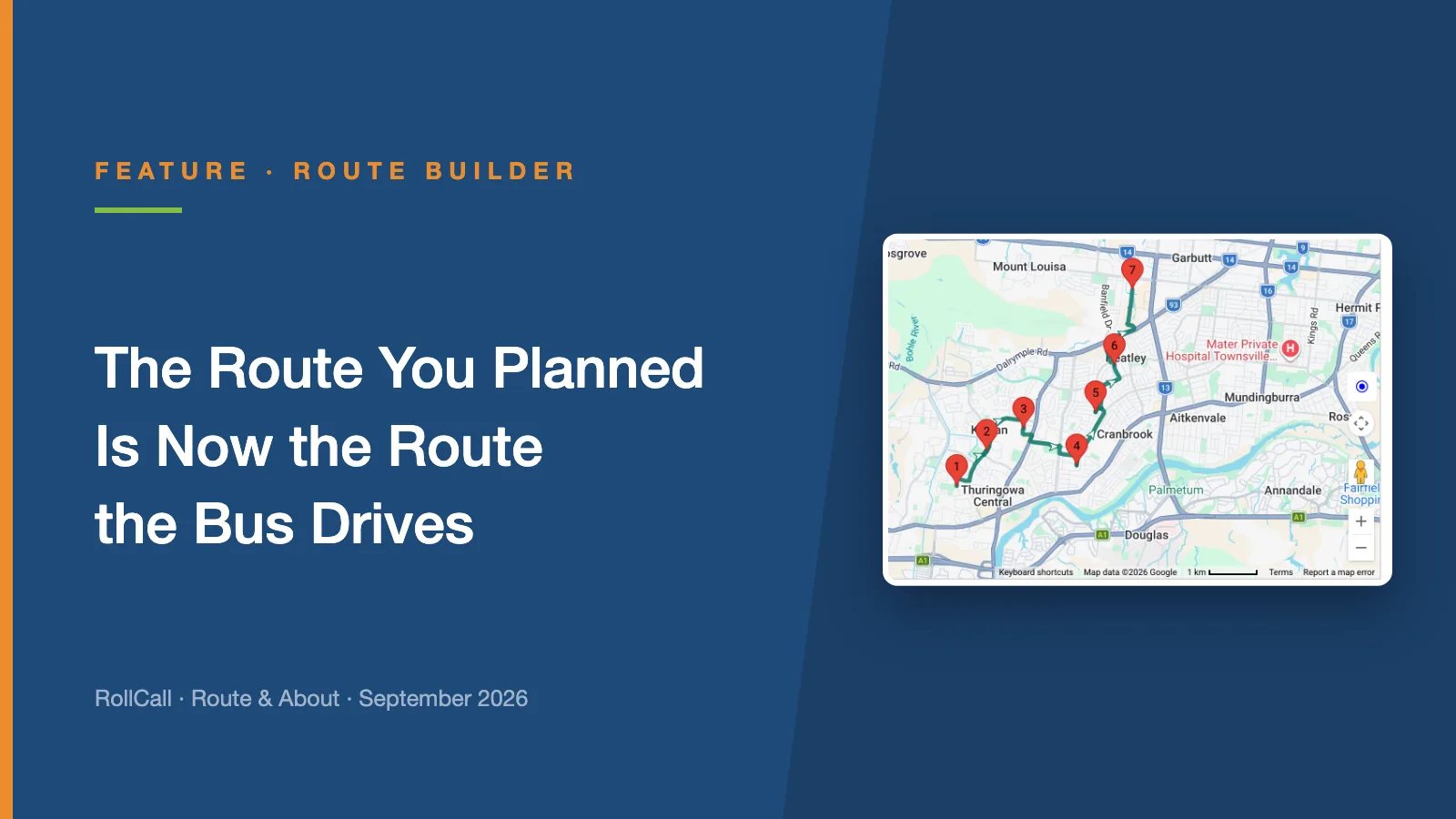
Until now, driver navigation found its own way between your stops. Plan Navigation lets you set the exact road, and the driver app follows it turn by turn.
Updated 1 October 2026: part one of the intake workflow is now in RollCall. Ask Support for your 2027 form link and share it with families today. Applications land straight in your Intake tab, ready to work through.
The gap that has always sat outside RollCall - and how we've closed it.
There are three ways student information gets into RollCall, and most schools use one of them.
Manually. Someone opens Add Student and types in the details, one family at a time. It is slow, but it is completely under your control, and for a school adding a handful of students a term it is perfectly sensible.
By CSV. The enrolments team exports a file and you import it. Two hundred students in one go, which is why most schools reach for this in November.
By integration. An API connection to your student management system keeps RollCall in step automatically. Students appear as they enrol. Nobody types anything.
All three work well. If you are using one of them, you have every student in your school sitting in RollCall with their year level, their address and their parents attached.
And you still have no idea which of them want to catch the bus.
This is the strange thing about transport administration, and it catches new customers by surprise.
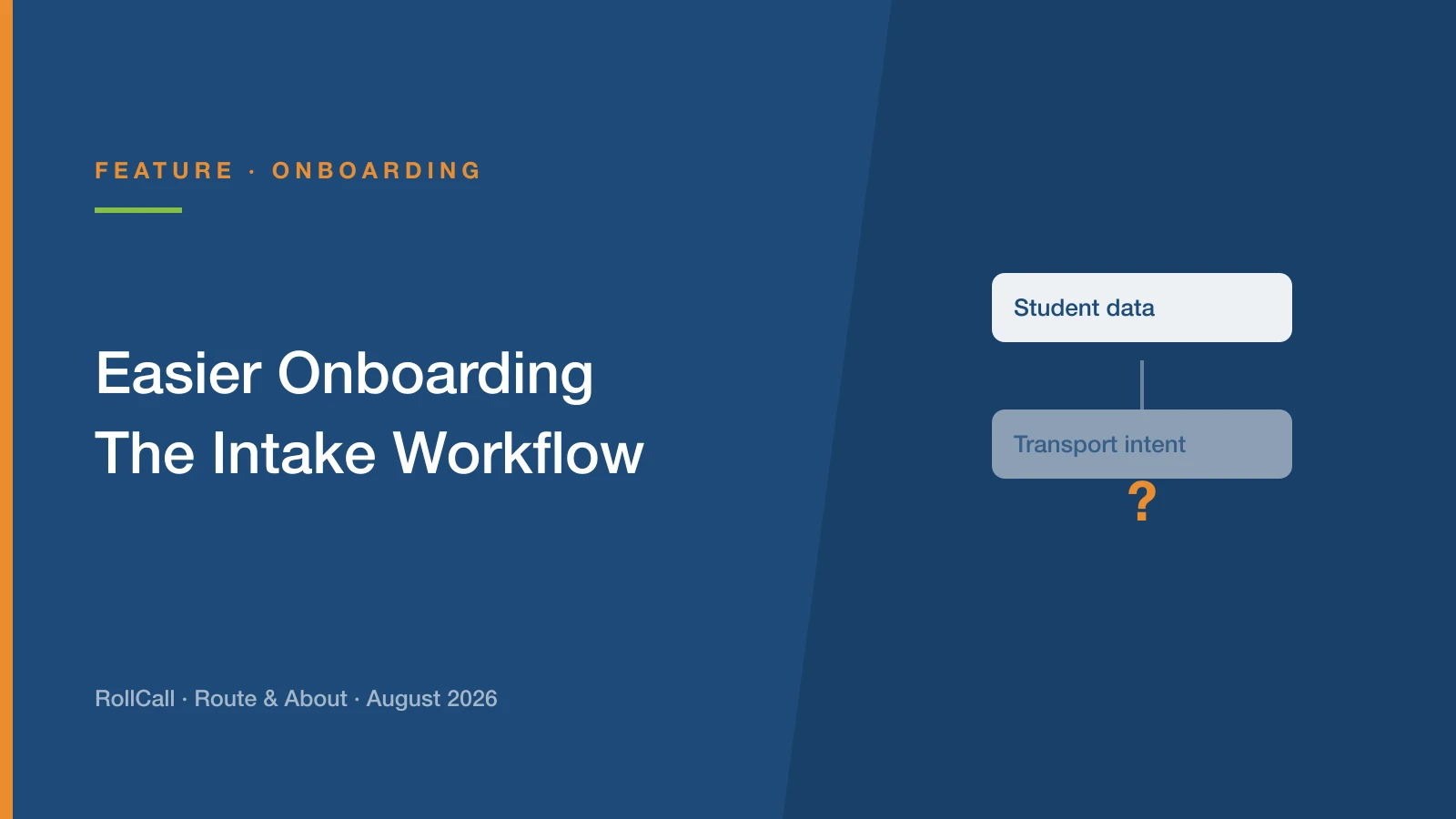
Student data and transport intent are two completely different things. Your student management system knows everything about a child except the one fact your transport office needs: whether their family wants a seat on a bus, which one, and from where.
That is not a failing of the integration. Nobody ticks a box at enrolment saying "yes, the bus, Tuesdays and Thursdays, from the corner of Wattle Street". It is a separate decision, made later, by a parent.
So the question becomes: how do you collect it?
Every school has invented something, and the inventions are remarkably consistent.
A Google Form. Quick to build, free, and it does collect expressions of interest. The responses land in a spreadsheet.
An external sign-up or permission platform. More polished, often already used for excursions and consent forms, and it produces a tidy export.
An email to the transport office. The most common of all. A parent emails to ask about the bus, and a human takes it from there.
None of these are bad ideas. They are sensible responses to a real gap.
But look at what happens next in every single one of them.
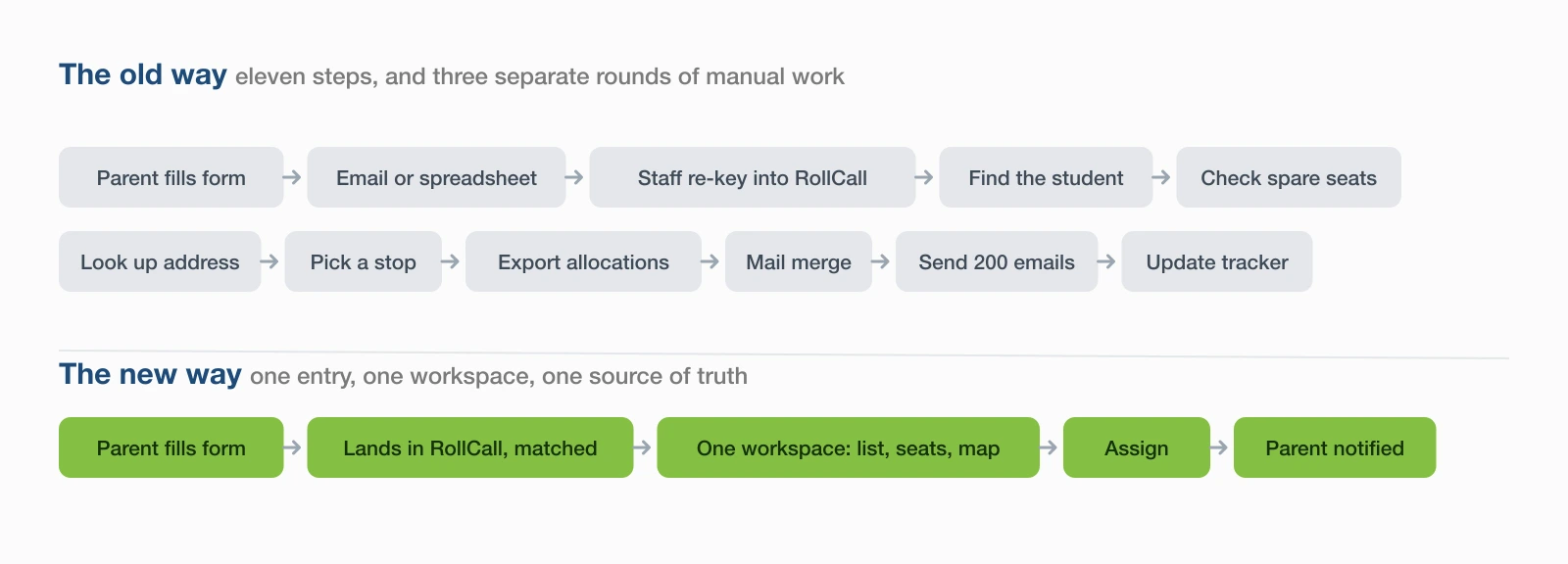
The parent types their details. Then somebody types them again.
The form fills up. Someone opens the spreadsheet. Someone reads down the rows and finds each student in RollCall. Someone emails the family to confirm. Someone updates a separate tracker so the office knows who has been approved, who is waiting, and who has been declined.
The information was captured correctly the first time. It just wasn't captured anywhere useful.
So it gets copied, exported, uploaded, re-keyed and chased - and every one of those steps is a chance for a family to be missed, a stop to be mistyped, or an application to quietly stall because the one person who knew about it was on leave.
Here is the part that actually consumes the afternoon.
Getting the sign-up list into RollCall is only the beginning. Every student on it still has to be put on the right route, at the right stop. Individually.
And for each one, that is three separate investigations.
Three different questions, answered in three different places, and then you write down the answer and start again with the next student.
Do that two hundred times and you have lost a week.
It is also where mistakes creep in. Allocate forty students to a route from a list, and unless you are keeping a running tally in your head or on paper, you will not notice you have overfilled it until someone can't get on the bus in February. Choose a stop from an address without seeing it on a map, and you will occasionally send a child across a highway they shouldn't be crossing.
None of that is carelessness. It is what happens when the three pieces of information you need are never in the same place at the same time.
There is one more step, and it lands right at the end when you are already tired of the whole business.
Every family now has to be told what they have been given. Their route. Their stop. What time to be there.
So you export the allocations. You open a mail merge. You build a template with the right fields in the right places, you check a few by eye to make sure the columns haven't shifted, and you send two hundred emails.
Then you field the replies from the families whose merge fields didn't populate, and the ones who deleted it, and the ones asking what time again.
It is the third export of the same information, to tell people something RollCall already knew the moment you allocated them.
The new intake workflow removes all three of those steps.
You take an embed code from RollCall and put it on your school's transport page. "Sign up for the bus here." It looks like part of your website, because it is.
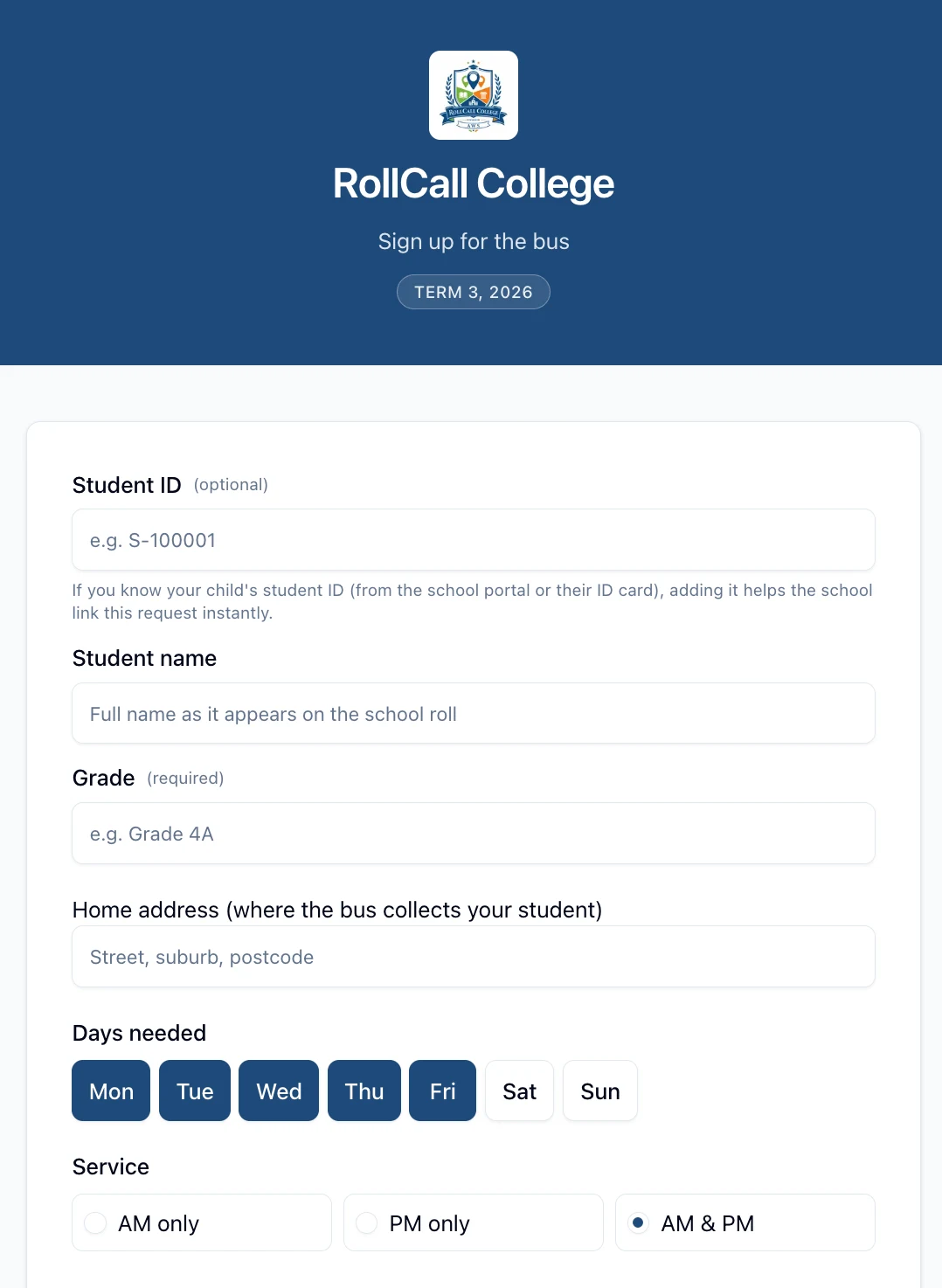
When a parent completes it, the application does not go to the transport team's inbox for a human to action.
It goes straight into RollCall.
And it does not arrive as a blank enquiry. By the time you look at it, RollCall has already matched the application to the existing student record.
Which means the work in front of you is not data entry. It is a decision.
This is the part that will save you the most time, and it is worth describing properly.
Instead of three lookups per student, you get one workspace with all three things in it at once.
Three questions, one screen, one decision. Then straight on to the next application.
That is the difference between allocating a cohort in an afternoon and allocating it over a fortnight.
From there, you choose how much oversight you want.
Auto-approval. Straightforward applications are confirmed automatically, and the family is told. Useful when demand is predictable and you would rather not be a bottleneck.
Review first. Every application waits for a human. You work through them in the workspace, choose the route and stop with the seats and the map in front of you, and confirm.
The moment a student is assigned, RollCall notifies the parent - their route, their stop, and their time, confirming the booking.
No export. No mail merge. No template with fields that need checking. No two hundred emails.
The information goes to the family from the system that holds it, at the moment it becomes true. And because it lands in the app rather than an inbox, it is still there in February when they have forgotten what time to be at the stop.
One entry. One workspace. One source of truth.
There is a second benefit here that is easy to overlook, and schools tend to feel it more than they expect.
Under the old way, an application in progress lives somewhere private. An inbox. A spreadsheet on one person's desktop. A printed form in the bottom drawer of a filing cabinet, in a system only one person fully understands.
When that person is away - or has moved on - nobody can answer a parent asking where their bus application is up to.
With intake in RollCall, every application has a visible status. Anyone with access can see what has come in, what has been approved, what is waiting and what was declined. The front office can answer the phone without walking down the corridor to ask.
That is not a headline feature. It is just the difference between a process and a filing cabinet.
Part one of the intake workflow is here now, and it will keep getting better from there.
Next on the list is instant confirmation to parents the moment their application is approved - including a payment link so families can secure their seat then and there, rather than waiting for an invoice to be raised and chased.
Application, approval, allocation, confirmation and payment, in one continuous flow that never leaves RollCall.
We are not messing around when it comes to reducing administration.
Every hour your transport team spends copying information between systems, or chasing three screens to seat one child, is an hour not spent on the things that actually need a person - the family in a difficult situation, the route that needs rethinking, the student who has been getting off at the wrong stop all term.
That is the work worth protecting.
If you are about to rebuild your sign-up form for next year, it is worth talking to us first. Part one of the intake workflow is here now - right when most schools open registrations - so there is no sense building something you are about to replace. Ask us for your 2027 form link and start collecting applications today.
Email support@rollcall.com.au.
Until now, driver navigation found its own way between your stops. Plan Navigation lets you set the exact road, and the driver app follows it turn by turn.
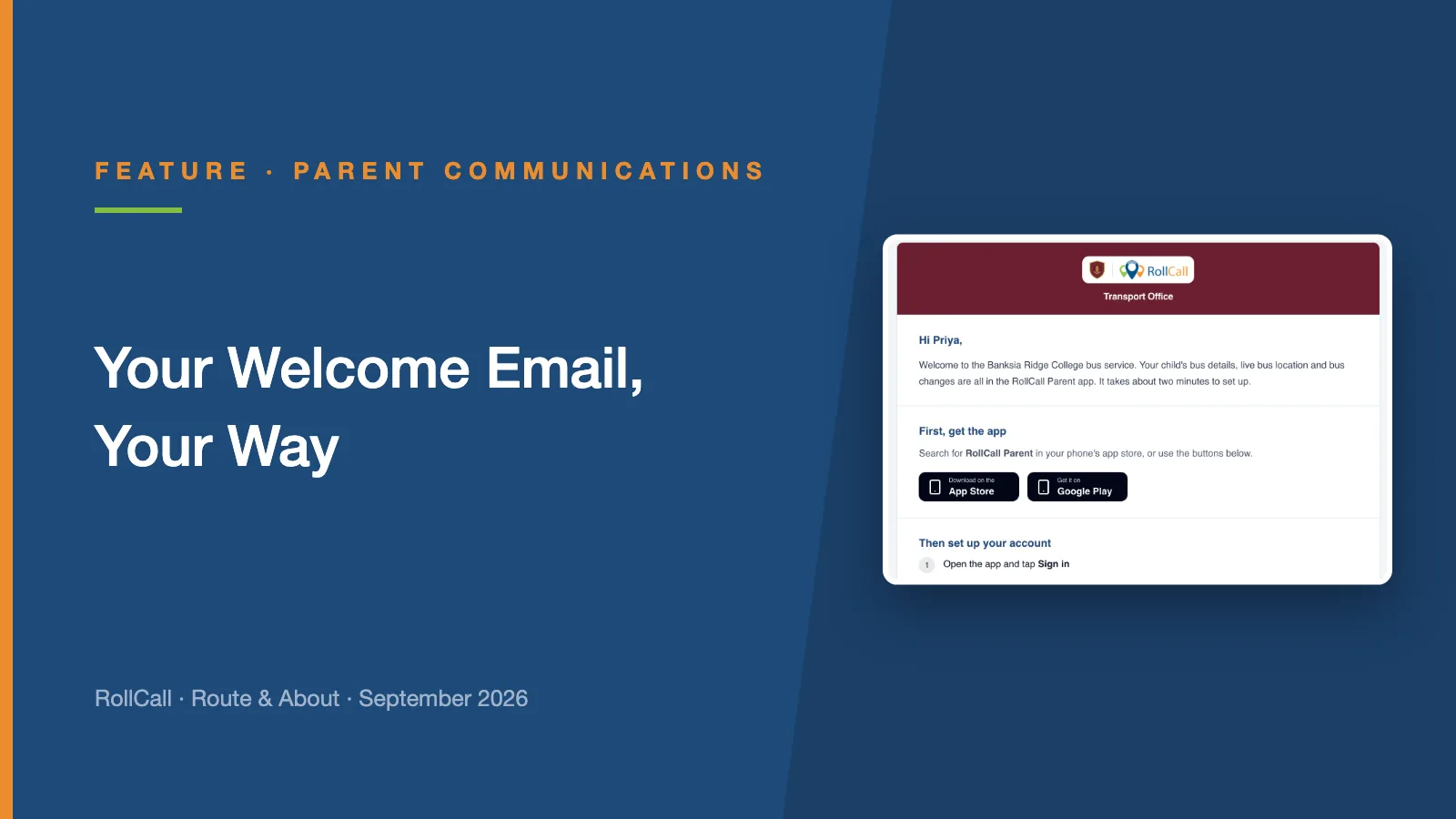
The welcome email is the first thing a new family gets from RollCall. Now your school runs it: your logo and colours, your wording, and a preview of exactly what families receive.
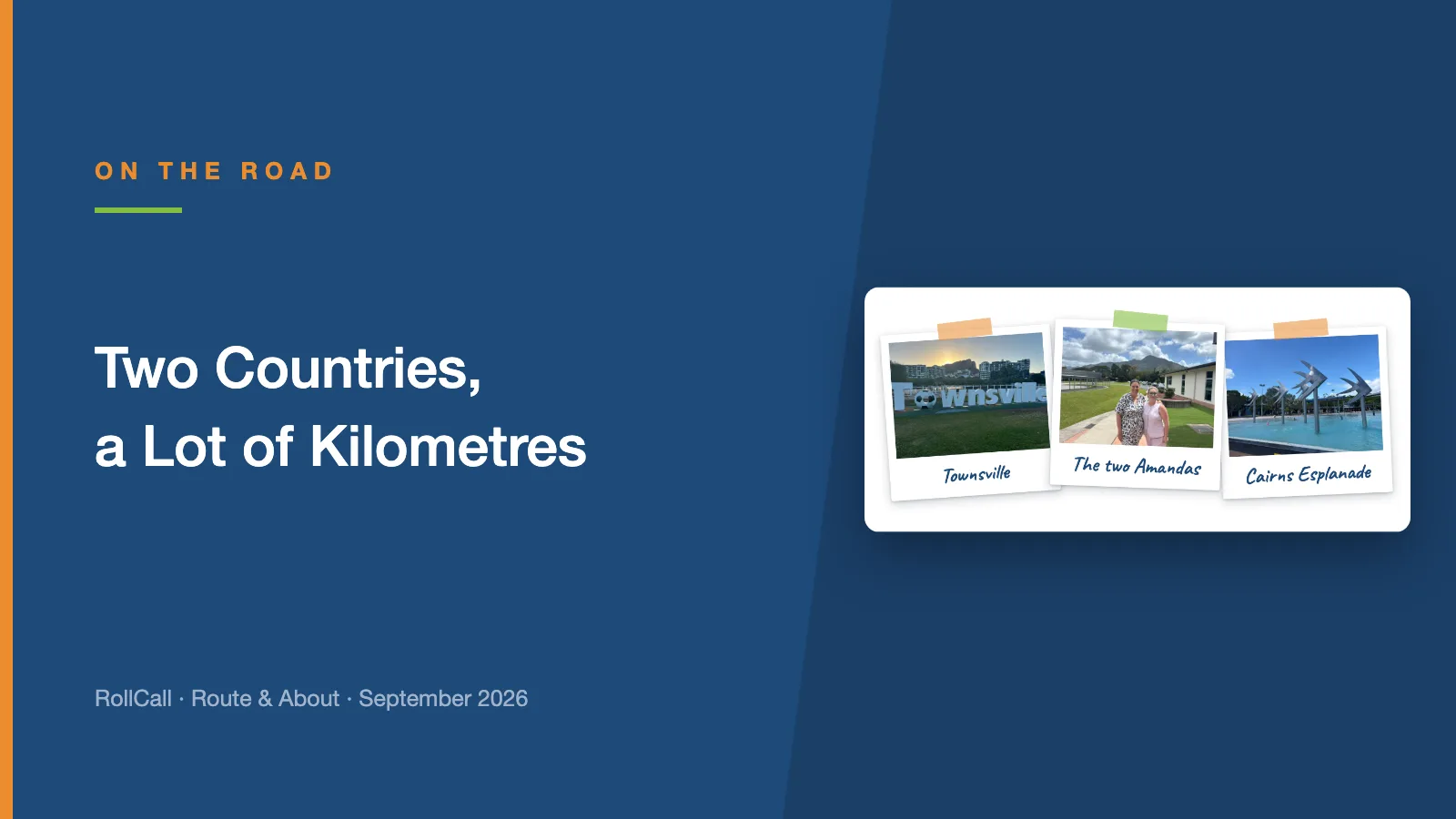
In the same week in September, Amanda visited our schools in Townsville and Cairns, and Dean took the RollCall stand to the SAHISA 2026 Conference in Durban.